BIND ME TIGHTER STILL
the long-awaited interview with author Lara Ehrlich!


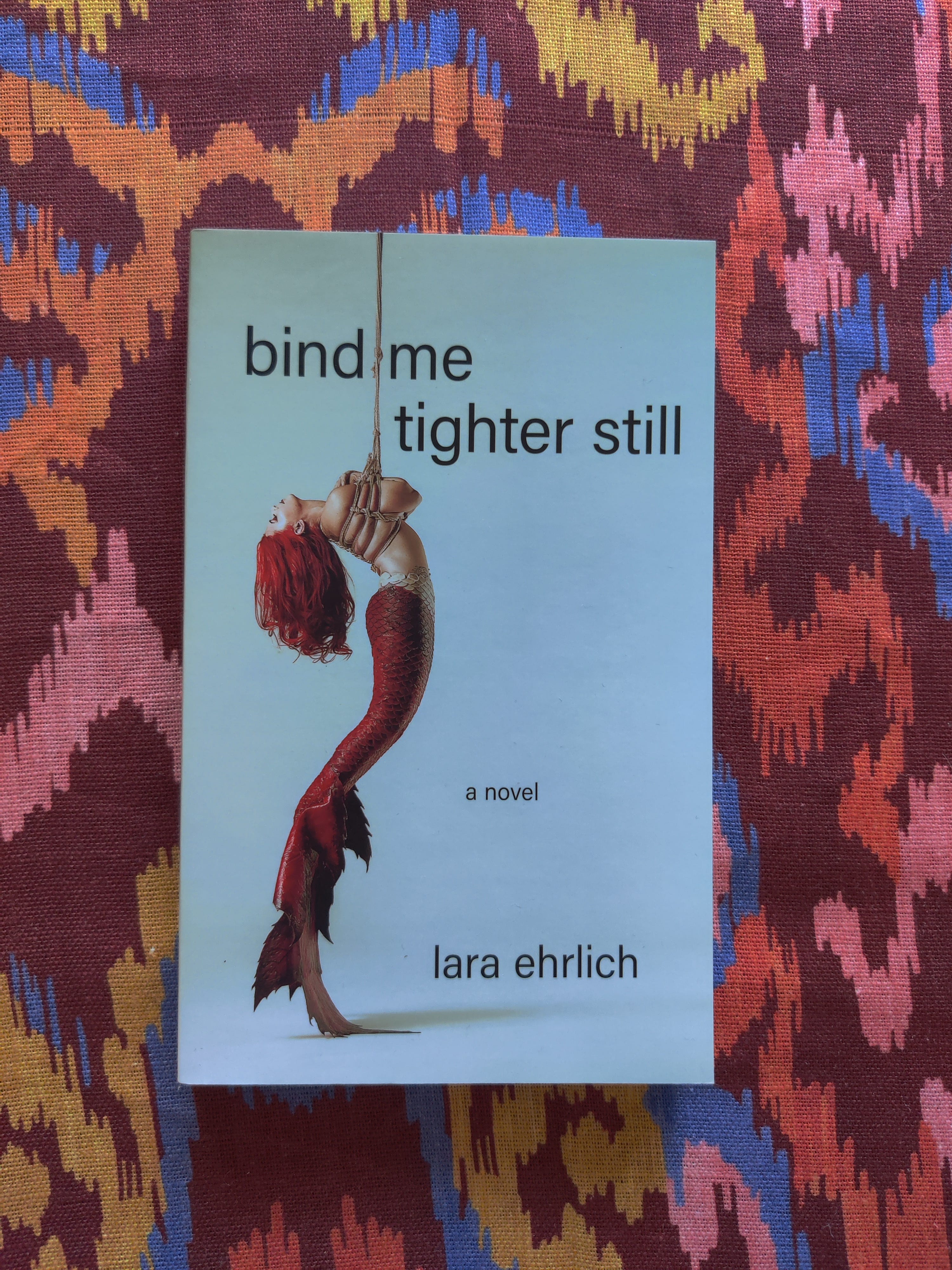
It is always a gift to have a life-long friendship, as Lara and I have had, since pre-school. We attended the New England Young Writers’ Conference at Bread Loaf together in high school and have spent a lifetime talking about books and writing. In the interview below, I ask Lara, author of the novel Bind Me Tighter Still and the short-story collection Animal Wife, the questions that haunted me after reading her novel.
TW: sexual assault / rape.
SOPHIA: Are you a Ceto (the mother character) or a Naia (the daughter character)? How does your identity (one’s identity) shift from being a daughter to being a mother? As we’re now in our “sandwich generation” era of caring for parents and children, how do you feel this book highlights the tension of being between two worlds?
LARA: I share Naia’s urgent desire to figure out who she is. I’m always striving to understand my ever-evolving self as I transition through different stages of life. At this stage, as a middle-aged mother, I also identify with Ceto.
The seed of this book is something my mother told me when I was pregnant: This is the closest you’ll ever be to your child. As soon as she’s born, she’ll start moving away from you. That’s deeply tragic, and yet it’s exactly what’s meant to happen. We want our children to grow up and become their own selves.
I am constantly gaining a new version of my child while losing the old one. It’s not that I’m actively grieving, because I’m always in awe of who my daughter is becoming, but there is a quiet sense of loss in that process.
I poured into Ceto my own ferocity as a mother, which took me by surprise. It’s a physical, animal instinct to protect my baby. That instinct never lessens. It just changes as she grows older and pushes outward, and as my fear of what could harm her shifts.
I also think about the tension of being between two worlds—the “sandwich era” of caring for parents and children. That’s on the horizon for me. My parents are still healthy, independent, and self-sufficient, but I can see a time when that will begin to change. Occasionally I catch glimpses of it.
There’s grief there, along with the understanding that aging is part of the natural turnover of generations. But that knowledge doesn’t help when you’re sitting across the table from the people you love most in the world, watching them grow older.
In terms of how that feeds into the book, I’m not sure I thought about it consciously, even while creating the matriarchal world of Sirenland. Women are drawn there seeking safety, empowerment, and community among other women. They band together around Naia and see her as their collective daughter.
She’s noticed how the sailors have started watching Naia. How their eyes skim the curve of her neck, the dip between her shells, the slope of her stomach. Their objectification of Naia makes her want to rip them apart—and yet, this is the cost of the world she has created for her daughter.
I find myself thinking about it more intentionally now, as the Epstein files are released, revealing that the web of patriarchal power—and its abuses—runs far deeper than many of us imagined. There’s a growing call to imagine alternatives to a system that has long centered male dominance. A matriarchal society, at least conceptually, centers children and, by extension, women, mothers, and communities organized around protecting the next generation.

SOPHIA: Can we talk about realism vs magical realism in this book? There are moments of deeply realistic, rooted-in-reality scenes, but the whole premise of the book is...a mermaid slicing her tail into legs. How do you tread the line between magic and real?
LARA: This is one of the elements I think about most: how to weave the real and the fantastical together so the fantastical feels intentional rather than accidental.
One approach is planting the seeds of the fantastic from the very beginning. Right away I ground the reader in the mermaid world—the idea that in this reality, real mermaids exist.
Another element is that in the magical realism I admire, the magic isn’t explained. It’s treated as matter-of-fact. Ceto takes a knife to her tail and becomes a woman. We don’t need the logistics—where she cuts, whether there were legs under the tail, or whether they grew out of the stump. I’m asking the reader to suspend disbelief and accept the fairy-tale logic.
I model that logic on fairy tale tradition, in which the mechanics of magic are never explained. In Sleeping Beauty, we don’t need to know why touching the spindle causes everyone to fall asleep. It’s simply a spell.
Another way I think about balancing magic and realism is through specificity of detail. Grounding fantastical worlds in concrete details makes them feel authentic. The more a reader can visualize a world, the more real it becomes.
Ceto coils around the man’s waist, constricting her scales until his face bulges. His bruised gut swells below her muscled tail. She fits against him, sliding along his belly, and presses her barnacled breasts against his chest. His flesh tears beneath her fingernails. She drives her mouth into his, reveling in his complex taste.
Because Bind Me is not high fantasy but a slant version of our own reality, the magic exists alongside the everyday. In this world, audiences suspend their disbelief when watching the siren shows, but they don’t have access to the deeper magic—the fact that they are actually watching a real mermaid.
Ceto is a heroine / anti-heroine whose worldview is built on a brutal self-determinism. She leaves the ocean because she hungers for more. She leaves her marriage because she hungers for more. For those of us who aren’t mermaids, how do we express this desire?
I’ve always had the ambition to be a writer. It’s my vocation and my driving force. It shapes everything I do—from my work to what I read to the conversations I have with friends. I came late to the desire for a home and family.
For me, the challenge is holding both things at once. They both demand so much that either could easily crowd out the other. I often feel like I’m failing in one realm or the other. I’ve come to accept that balance isn’t possible. The best I can do is try to be present in both and recognize that sometimes one will take precedence over the other.
For others, this tension might look different. It might mean leaving an unfulfilling job, leaving an unhappy marriage, or moving somewhere that better aligns with your values.
There’s vulnerability and bravery in pursuing self-determination, because you’re always sacrificing something.
Ceto sacrifices her tail for legs. She sacrifices her husband for independence. Her self-determination carries a selfishness I recognize in myself. I magnified that quality in her. She will stop at almost nothing until she confronts the limit of what she’s willing to sacrifice. I think we all reach that moment.

The rape scene on the bus is, for me, one of the most indelible scenes in the book. You and I have workshopped these kinds of sexual assault scenes and discussed them at length together. It’s a deliberate choice to include--not like two characters stopping to get ice cream, or walk in the park. As readers, we know more about Ceto when she gets off the bus because of this scene. But what does Ceto know about herself? About the world? Why was this scene important for you to include?
That was the last scene I wrote, after many drafts, because I felt something was missing. I had written a fairy-tale version of Ceto’s life on land: she leaves the sea and meets a man. He is the vehicle through which she learns what it means to live as a human woman–but he’s also using her. That’s the other side of the traditional fairy tale, where a man steals a woman (who is really a wild swan, a seal, a sleeping princess) to be his bride. He never asks whether she wants that life.
In an earlier draft, Ceto realizes she’s unhappy and leaves her husband; the next time we see her, she’s standing at Sirenland. I sensed something important happened in the space between.
First, I needed to show what was unfulfilling about her married life, beyond the archetypal trope. For Ceto, it’s the subsiding of passion. She becomes human in the first place because she wants to experience the extremes of human emotion. Instead, she settles into a life that feels calm and content. Her husband reflects back to her a version of herself she hates: a tame housewife who does not inspire passion.
This propels her away from him, but it isn’t enough to explain why she would go on to build an empire of women that thrives on mastering the male gaze.
The bus scene is that spark. In that moment, surrounded by men who threaten her child if Ceto does not obey, she sees herself reflected back as a victim, and that vulnerability is tied directly to her love for her daughter. Protecting Naia is what prevents her from fighting back.
Ceto willed Naia not to wake. She fixed her eyes on one of the gold buttons of his jacket, holding her breath against the ripe stink of him, and lifted her chin. As he forced himself down her throat, she longed to bit through layers of tissue and nerve, to hear him scream as she devoured the inconsequential part of this man that made him believe he had power over her.
That moment becomes the catalyst for her transformation. Her love for her daughter becomes the force that drives her to build a world where Naia will be safe. More importantly, if Naia is safe, then Ceto’s love for her no longer makes her vulnerable.
She creates this world by using men’s toxic desire against them, building her empire by taking their money and manipulating their expectations while quietly holding the power herself. She becomes the one directing their hunger.
At the same time, the scene was anxiety-provoking to write because I didn’t want it to be read simplistically, as though sexual violence alone explains who she becomes. That would flatten the character and risk reducing the complexity of sexual trauma.
Instead, the scene intensifies forces already present in her: her hunger for power, her ferocity as a mother, and her determination to build a world in which she will never again feel powerless.
Many thanks to Lara for this brilliant conversation!
This week in A Return to Reading:
I’ve returned! Right after the holidays I started an intensive fiction workshop and it absorbed all of my spare time but now I’m back, baby.
And I’m obsessively playing CrossPlay…
And watching The Pitt. Why is Dr Al-Hashimi so annoying? Will she be redeemed? Why is Dr Robby so perfect? Apart from not wearing his motorcycle helmet, of course, but it would crush his perfect hair so…

 | A guest post by
|